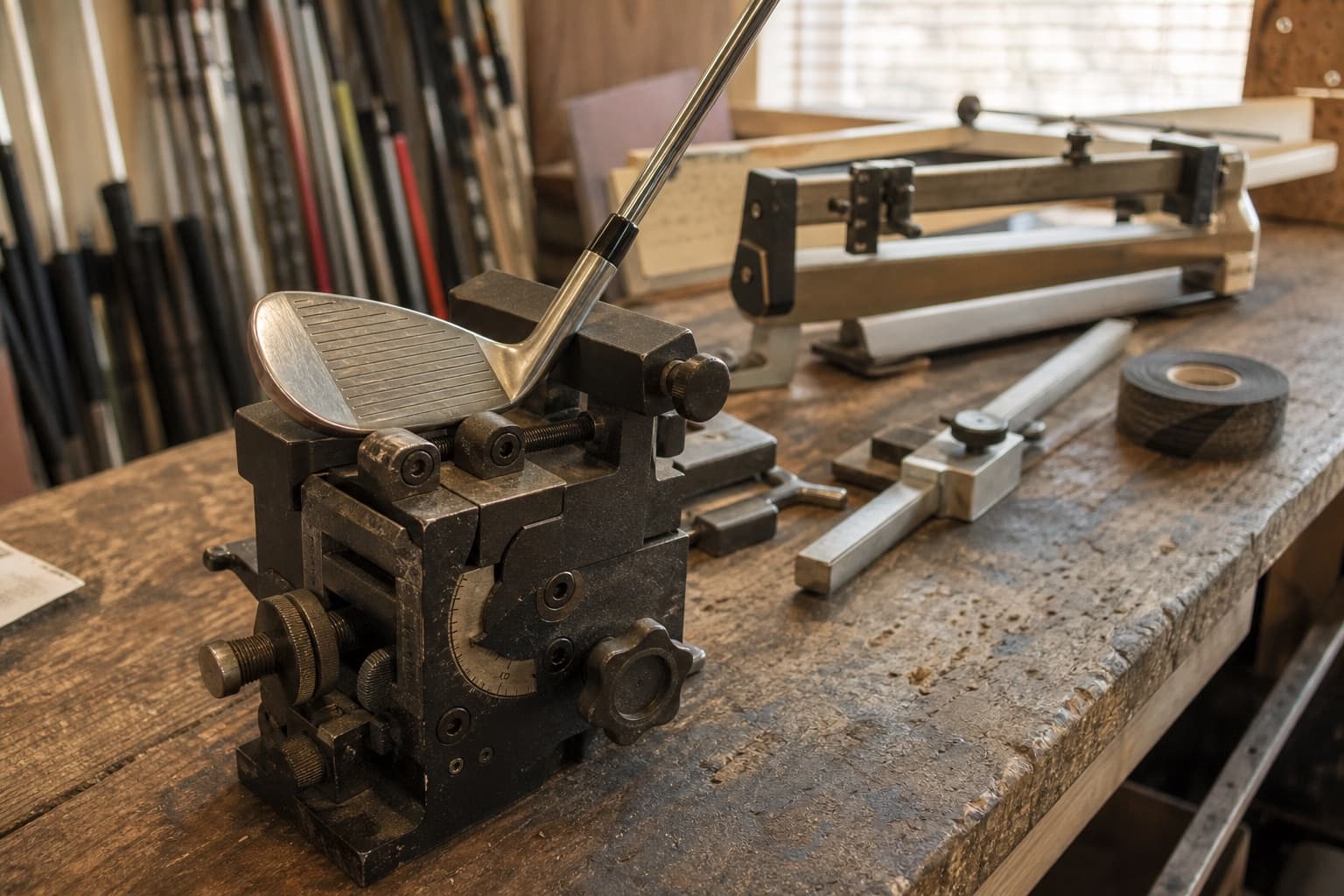
Most golfers know the number stamped on the sole of an iron and the loft printed on a driver. Very few know what their clubs actually measure, and the two are often not the same. Lofts drift when a set is bent, lie angles get knocked around in the trunk, and a regrip or a cut-down shaft quietly changes how a club feels.
This is the list of measurements we take during a bag assessment, what each one means, and roughly how much it matters. None of it requires a launch monitor. All of it can be checked on a bench in a few minutes per club.
Loft
Loft is the angle of the clubface relative to the shaft, measured in degrees. It is the single biggest factor in how high a shot launches and how far it carries.
A few things worth knowing:
- The stamp is not a standard. One maker's 7-iron may be 28 degrees and another's 34. That alone can be a club and a half of distance between two "7-irons."
- Irons drift. Forged irons especially can move a degree or two from repeated use or a trip through a bending machine years ago. We see sets where two neighboring irons sit within a degree of each other.
- Gapping is the point. What matters is the step from one club to the next. Most sets are built around a 4 degree step between irons, which works out to roughly 10 to 15 yards for most players. Where that step collapses or doubles, you have a gap in the bag.
Most forged and many cast irons can be bent a couple of degrees either way. Wedges are the most common fix: tightening the step between a pitching wedge and a gap wedge is a cheap way to remove a 25 yard hole.
Lie angle
Lie angle is the angle between the shaft and the ground when the club is soled flat, also in degrees. A typical 7-iron sits somewhere around 62 degrees, with each club in the set a half degree or so apart.
Lie matters because of where the sole touches the turf at impact. If the toe is up (too upright for you), the face points left of the target for a right-handed player. If the heel is up (too flat), it points right. At 7-iron distance a lie that is off by a couple of degrees can push a well-struck shot several yards offline, and the miss gets bigger as the loft goes up, which is why wedges are the most sensitive clubs to lie.
We check lie with a lie board or tape on the sole and a few swings. The ideal mark is in the center of the sole. Like loft, lie is adjustable on most irons and wedges within a few degrees.
Length
Club length is measured from the ground to the end of the grip cap with the club soled at its normal lie angle. A standard men's driver today is about 45 to 45.75 inches and a 7-iron about 37 inches, with half-inch steps through the set.
Longer is not automatically farther. A longer club has a wider arc, but it is also harder to hit in the center of the face, and center contact is worth far more than a fraction of a mile an hour of clubhead speed. Plenty of golfers gain distance with a driver that has been shortened an inch. Length also interacts with lie: a longer club plays more upright, a shorter one more flat.
Swing weight
Swing weight describes how heavy the head feels during the swing. It is measured on a scale that balances the club on a fulcrum 14 inches from the grip end and reads out as a letter and a number, such as C9, D0 or D2. A higher reading means the club feels more head-heavy.
Most men's steel-shafted irons are built in the D0 to D2 range, and lighter graphite or women's sets usually land in the C range. The scale is sensitive:
- About 2 grams added to the head raises swing weight one point.
- About 5 grams added at the grip end lowers it one point.
- Changing length by half an inch moves it roughly 3 points.
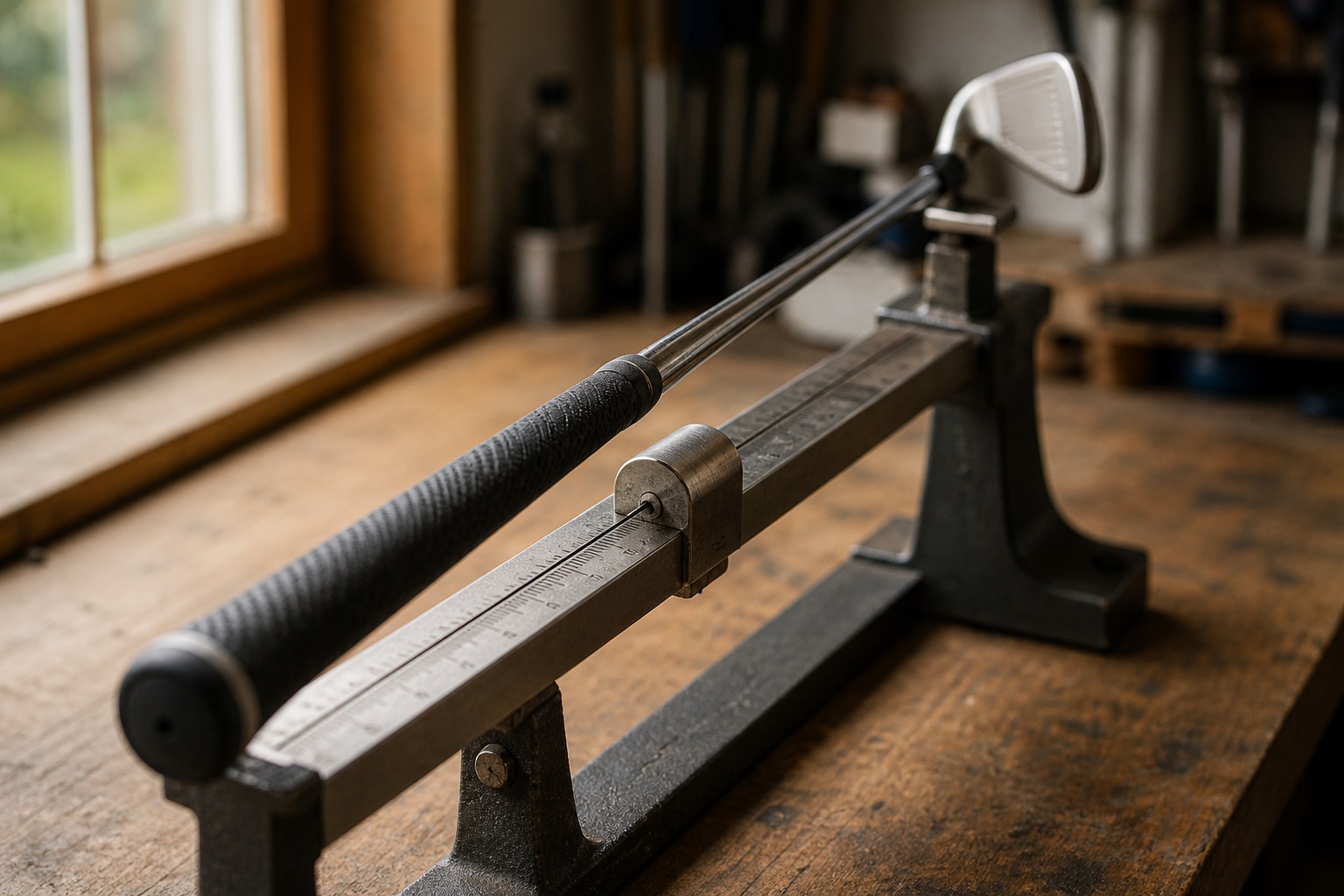
That is why a club can feel different after an ordinary regrip. Swapping a 50 gram grip for a 65 gram midsize grip takes roughly 3 points off the swing weight, and the club feels lighter in the head than it did. We match swing weight across a set so every club feels the same, and we check it after any length or grip change.
Total weight and MOI
Total weight is simply the club on a scale, in grams. It is driven mostly by the shaft, and it is a bigger factor in tempo and fatigue than most people expect. A set with 130 gram steel shafts and one with 90 gram graphite will feel like different sports.
MOI (moment of inertia) is an alternative to swing weight that measures how hard a club is to swing around a pivot. Some fitters match sets by MOI rather than swing weight so that longer clubs do not feel progressively heavier. Either method works; the point is consistency through the set.
Shaft flex, weight, torque and kick point
The shaft has its own set of numbers, and they are the least standardized of all.
| Measurement | What it is | Why it matters |
|---|---|---|
| Flex | How much the shaft bends under load, labeled L, A, R, S or X | Labels vary by brand. One maker's R can be stiffer than another's S. |
| Frequency | Stiffness measured in cycles per minute (CPM) on a frequency analyzer | A real number that lets you compare shafts across brands. |
| Weight | Grams, from the 40s for light graphite to 130 for heavy steel | Affects total weight, tempo and how the club loads. |
| Torque | Degrees of twist under load | Lower torque feels firmer; higher feels smoother. |
| Kick point | Where along the shaft it bends most | A lower kick point tends to launch higher. |
When somebody tells us a shaft feels "boardy" or "whippy," we put it on the frequency analyzer. The CPM number settles the argument.
Grip size
Grip size is measured by the outside diameter, built up from the shaft's butt diameter and the grip's core size. A standard men's grip is the baseline; midsize is about 1/16 inch larger and jumbo about 1/8 inch larger. Each extra wrap of tape under the grip adds about 1/64 inch, which is how fitters hit sizes in between.
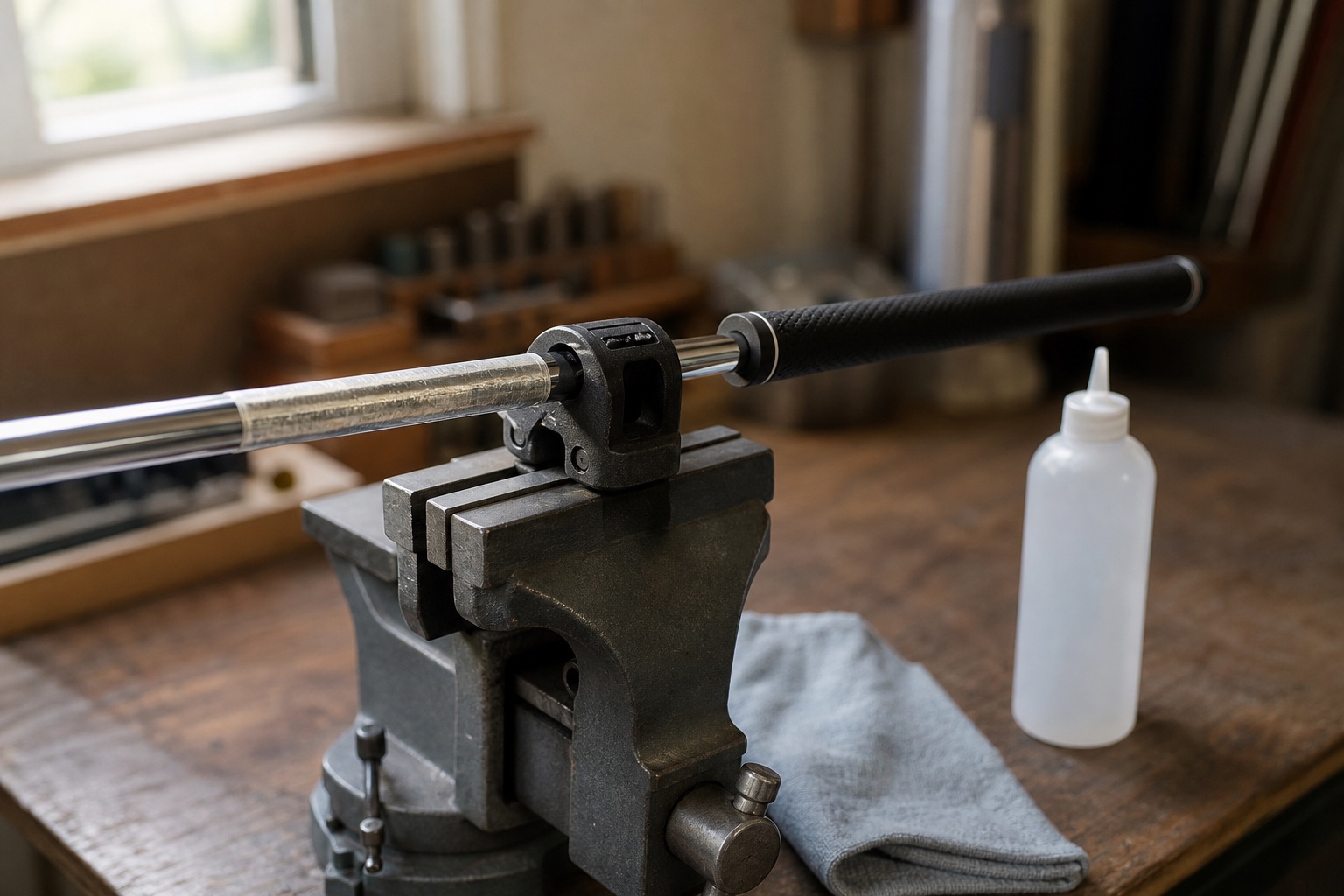
Grip size is partly hand size and partly preference. Too small and some players grab harder and get handsy; too large and it is harder to release the club. Worn grips matter more than size for most golfers. If yours are shiny or slick, that is the first and cheapest fix in the bag.
Bounce and grind (wedges)
Bounce is the angle between the leading edge and the lowest point of the sole, in degrees. More bounce keeps the leading edge from digging. Low bounce (roughly 4 to 6 degrees) suits firm turf and shallow, sweeping swings. Mid bounce (7 to 10) is the all-rounder. High bounce (11 and up) suits soft turf, sand, and steep swings.
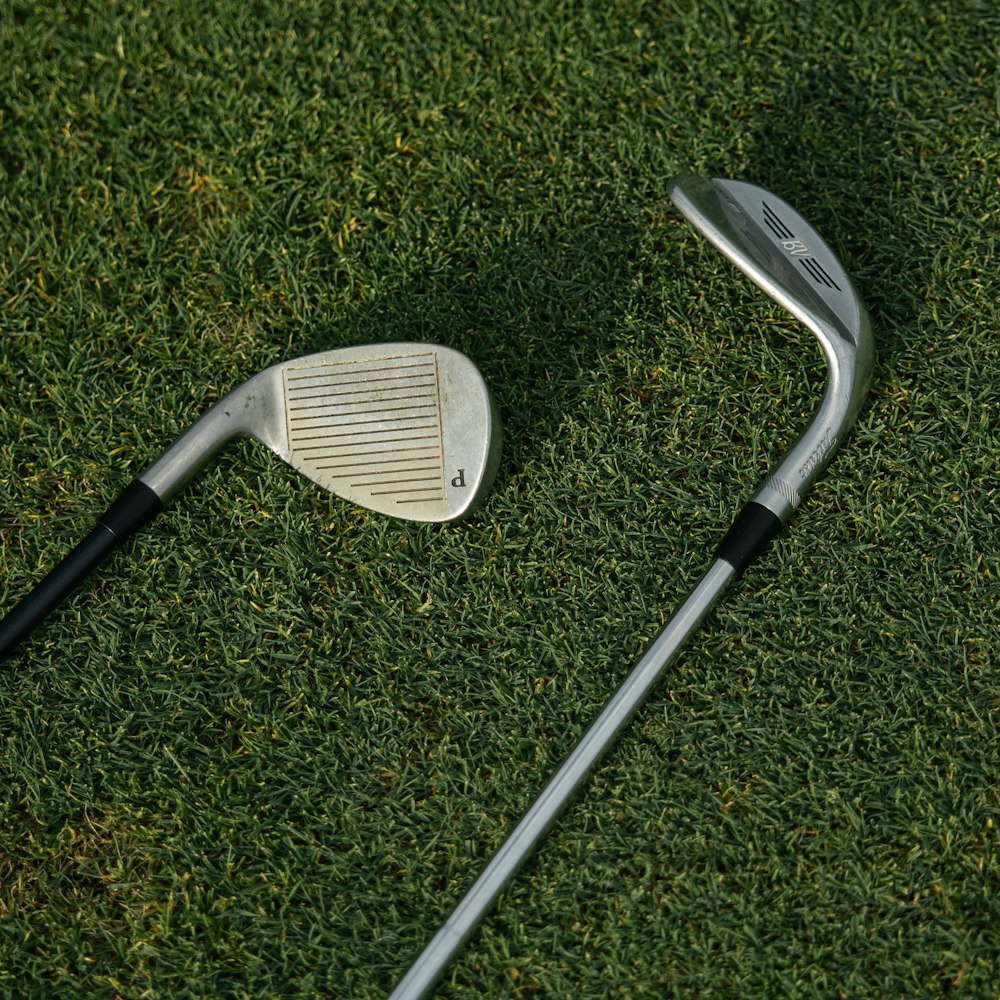
Grind is how the sole has been shaped, usually by removing material from the heel or toe so the club can be opened without the leading edge lifting. It is not a single number, but it changes how a given bounce plays.
Offset and face angle
Offset is how far the leading edge sits behind the hosel. More offset gives the face a fraction longer to square up and tends to raise launch, which is why game-improvement irons have more of it. Face angle on woods and drivers is measured in degrees open or closed and has a direct effect on starting direction; many adjustable hosels change face angle along with loft.
What is worth changing
Measured against each other, the clubs in most bags have at least one of these problems: a gap in loft, a lie that does not match the player, a set that is not matched in swing weight, or grips that are simply worn out. All four are inexpensive to fix compared to new clubs.
The right order is usually to measure first, then decide. That is what the bag assessment is for, and anything you choose to adjust afterward is priced from our regular services list.